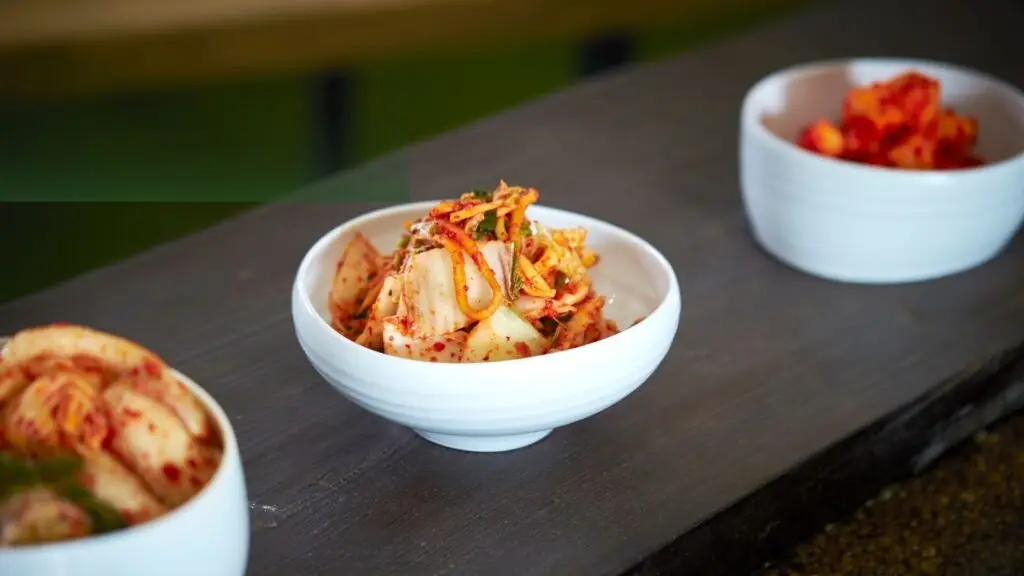
The kimchi section at H Mart is not a shelf. It’s a wall.
Refrigerated cases running the length of an aisle, packed with tubs and pouches in a dozen sizes, most of them labeled in Korean, some of them containing things that don’t look like the kimchi you’ve had at a restaurant at all. If you’ve stood there for five minutes and then walked away with nothing, you’re in good company. I’ve watched people do it.
Here’s the thing I want to be upfront about: there is no correct answer, and Koreans argue about this constantly. Ask in any Korean-American group online which brand to buy and you will get forty replies and no consensus. Someone’s grandmother’s recipe is the standard. Someone else grew up in a different province with a completely different style. Someone will insist that all store kimchi is a compromise, which — fine, but we’re all buying it anyway.
So I’m not going to pretend there’s an objectively best kimchi. What I can give you is the shortlist that keeps coming up, the one I’d hand you if you made me choose, and enough context to figure out your own preference faster than I did.
The three names that keep coming up
Strip out the personal loyalties and the same handful of brands surface in almost every conversation.
종가집 Jongga The most established name in Korean kimchi. It’s the specialist brand — kimchi is their identity, not a side product — and they’ve been at it for decades. Consistent, widely distributed, and the one you’re most likely to find at any H Mart in the country. (They’re made by Daesang, the same company behind the Chung Jung One gochujang I wrote about [here].)
오씨네 Ossine A name that comes up constantly in Korean-American communities, often with real affection. People who like it tend to describe it as tasting closer to homemade — less uniform, more assertive. If your store carries it, it’s worth a try once you know what you like.
농협 풍산 Nonghyup Pungsan Nonghyup is Korea’s national agricultural cooperative, which gives this one a certain built-in credibility around sourcing. Another frequent recommendation, though distribution in the U.S. is spottier.
And then there’s Bibigo. CJ’s Bibigo kimchi is the most visible option — it’s in mainstream American supermarkets, not just Korean ones, and for a lot of people it’s their first kimchi. I’ll be honest: it’s not my preference. It reads as smoothed-out to me, tuned for a broad palate rather than for the sharpness I want. Plenty of people disagree and buy it happily. But since you’re asking me, that’s my answer.
If I had to pick one: 종가집 Jongga
This is what I’d tell a friend standing in front of that wall with no idea where to start.
It’s the specialist. Long history, deep experience, and a company whose reputation in Korea rests on kimchi specifically. That consistency matters more than you’d think when you’re new — you want a baseline before you start chasing preferences.
It comes in small packages. This is the practical reason and honestly the bigger one. Jongga sells kimchi in modest sizes, which means trying a new variety costs you a few dollars instead of committing you to a two-pound tub of something you might not like. When you’re figuring out your taste, low stakes matter.
The range is wide. This is where it gets fun, because most Americans think “kimchi” means one thing and it absolutely does not:
- 배추김치 Baechu-kimchi — napa cabbage. The default, the one you picture. Start here.
- 열무김치 Yeolmu-kimchi — young summer radish greens. Lighter, brighter, wonderful with cold noodles or mixed into a bowl of rice in hot weather.
- 총각김치 Chonggak-kimchi — whole small radishes with the greens attached. Crunchy in a completely different way. My personal favorite texture.
- 파김치 Pa-kimchi — scallion kimchi. Intense, pungent, not a beginner’s kimchi, and extraordinary with grilled pork belly.
Buy the napa first. Then, once you’ve got a feel for it, come back and grab a small pack of chonggak or yeolmu. That’s the fastest route to actually understanding what kimchi is, and it costs about twelve dollars.
How to buy kimchi well
Check the date, and know what it tells you. Kimchi isn’t going bad on that date — it’s a fermented food, it’s alive, and it keeps changing. A very fresh package will be crisp and mild, closer to a spicy pickle. An older one will be sour, soft, and deeply savory. Neither is wrong. Fresher for eating raw, more fermented for cooking.
Look at the package. If it’s puffed up, that’s carbon dioxide from active fermentation. It’s a sign of life, not spoilage. (It’s also why you should open it over the sink the first time. I’m telling you this so it doesn’t happen to you the way it happened to me.)
Refrigerate it immediately and keep it there. Left at room temperature it ferments fast.
Read the label if it matters to you. Most kimchi contains jeotgal — salted fermented seafood, usually anchovy or shrimp — which is what gives it depth. If you’re vegetarian or vegan, look for vegan-labeled versions; H Mart carries several.
Use a clean utensil, and press the cabbage down under the brine after you take some out. That brine is what protects it.
What to do with it as it ages
This is the part I wish someone had explained to me sooner. Kimchi has two lives, and the second one is arguably better.
Weeks 1–3 (fresh, crisp): Eat it as a side dish. Straight from the container, cold, next to rice.
After that (sour, soft): Now it’s a cooking ingredient, and a great one.
- Kimchi jjigae — the sourer the kimchi, the better the stew. This is the single best use for a container that’s gone past its prime.
- Kimchi fried rice — day-old rice, chopped kimchi, a fried egg on top.
- Kimchi pajeon — chop it, drain it well, fold it into pancake batter. My [seafood pancake recipe] converts directly.
- In grilled cheese, on a burger, in a quesadilla. Not remotely traditional. Extremely good.
Never throw out sour kimchi. In Korea it’s not a problem to solve; it’s a different ingredient you now have.
Frequently asked questions
How long does kimchi last? Months in the refrigerator, and it keeps fermenting the whole time. It gets sour rather than spoiled. Toss it if it grows fuzzy mold or smells genuinely off — sharp and sour is normal, rotten is not.
Is store-bought kimchi as good as homemade? No, but it’s much better than people expect, and homemade is a real project. Buy it for a year, then make it once and see if you care about the difference.
Which one is least spicy? Napa kimchi is generally the mildest of the standard varieties, and white kimchi (백김치 baek-kimchi) has no chili at all — it’s a good entry point if heat is the barrier.
Is kimchi actually good for you? It’s a fermented vegetable, so it brings live cultures and fiber. It’s also quite high in sodium. Treat it as a flavorful side, not a health supplement.
Should I buy the big tub to save money? Not at first. Get the small size, decide whether you like it, then size up. This is exactly why I point people to Jongga.
Can I get kimchi delivered if I don’t have an H Mart? Yes — Weee! ships it, and it arrives cold. I wrote about ordering from them [here].
What’s in your fridge right now? I want to know which camp you landed in. @season.of.seoul