If you’ve been to Korea, you’ve had one. Probably at eleven at night, standing in a GS25 or a CU with a bottle of banana milk, holding a plastic-wrapped triangle and trying to figure out which tab to pull first.
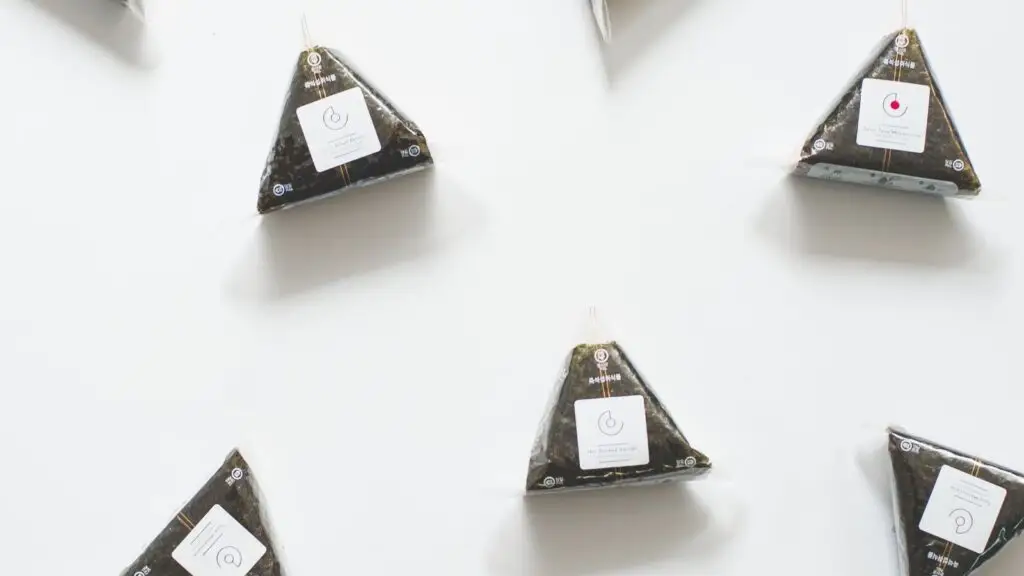
삼각김밥 (samgak gimbap) — literally “triangle kimbap” — is the most quietly perfect convenience food ever engineered. Rice, a savory filling, and a sheet of nori that is kept physically separated from the rice by a strip of film until the exact moment you open it. You pull three numbered tabs, the film slides out, the nori wraps itself around the rice, and it is still crisp. Somebody solved a real problem there.
For years I assumed this was factory technology. It isn’t. The wrappers are sold on Amazon, they cost a few dollars for a stack of them, and they work exactly the same way at your kitchen counter. Add a plastic mold and you can make a week of lunches in fifteen minutes.
This is now my most-repeated lunch, and I want to walk you through the simplest possible version.
The two things you need to buy
Neither is expensive, and both last through a lot of rice balls.
1. Triangle seaweed wrappers
These are pre-cut nori sheets sandwiched in the plastic film, with the numbered pull tabs and — importantly — the little stickers to seal them closed. This is the whole trick. The film keeps the nori dry and crisp until you eat it, which is why a rice ball you made this morning doesn’t turn soggy in your bag by noon.
triangle seaweed wrappers, Amazon
Search “triangle onigiri wrappers” or “samgak gimbap seaweed” if the link ever goes stale. A pack usually runs a few dollars for 50–100 sheets, and they keep indefinitely in a dry cupboard.
2. A triangle rice mold
A cheap two-piece plastic press: fill the base, press the lid down, pop out a perfect triangle. You can shape these by hand with wet palms, and Korean and Japanese cooks have done that forever. But the mold makes them uniform, it makes them fast, and uniform matters here because the wrapper is cut to a specific size.
Buy the multi-shape set, not a single triangle mold. The sets come with three molds, and one of them is the long rectangle for Hawaiian Spam musubi. It’s the same few dollars for a completely different lunch, so there’s no reason to buy the triangle alone.
The rice matters (a little)
Use medium-grain rice — Calrose is the standard American supermarket option and it’s exactly right. It’s sticky enough to hold a shape without being gluey.
Long-grain rice (basmati, jasmine) will not hold together. This is the one substitution that genuinely doesn’t work.
One note on seasoning: most Korean samgak gimbap is made with plain rice, or rice with a touch of sesame oil and salt folded through. Some people do add a splash of vinegar, and there’s nothing wrong with that — it firms the rice slightly and helps it keep. It’s a preference, not a rule. What I’d avoid is a full sushi-rice treatment (vinegar plus sugar plus salt, the way you’d season rice for maki), which pushes the flavor somewhere else entirely and fights with fillings like tuna mayo or bulgogi.
Start plain. Add sesame oil next time. Try a little vinegar after that if you’re curious.
Let the rice cool until it’s just warm before you shape it. Steaming hot rice will fog the wrapper and soften the nori.
The simplest version: tuna mayo
This is the classic. It’s the flavor that outsells everything else in Korean convenience stores, and it takes about four minutes.
Ingredients (makes 3–4 rice balls)
- 1½ cups cooked medium-grain rice, slightly cooled
- 1 can (5 oz) tuna in water or oil, drained very well
- 1–2 teaspoons mayonnaise — genuinely just a little; you want the tuna bound, not creamy
- Pinch of salt
- Pinch of black pepper
- Optional: ½ tsp toasted sesame oil in the rice, a few sesame seeds
Kewpie mayo is the traditional choice and it’s richer and eggier than American mayo. Regular mayo is completely fine.
Instructions
1. Mix the filling. Drain the tuna hard — press it against the lid of the can and pour off everything. Wet filling is what makes a rice ball fall apart. Then stir in the mayo, salt, and pepper.
2. Season the rice (optional). A small drizzle of sesame oil and a pinch of salt, folded through. Skip it if you want the plain convenience-store taste.
3. Fill the mold. Wet the inside of the mold lightly so nothing sticks. Add rice to fill it about halfway, press a shallow well in the center with your thumb, spoon in a tablespoon of the tuna, then cover with more rice up to the top.
4. Press and release. Put the lid on, press down firmly and evenly, then pop the triangle out.
5. Wrap it. Set the triangle in the center of the wrapper’s nori panel, fold the sides in following the printed guides, and seal it with the included sticker. That sticker is not decorative — it’s what holds the whole assembly together.
6. Refrigerate, or pack it and go. They keep well for a day. Peel the film off right before eating: pull tab 1 across the top, then tabs 2 and 3 down each side, and the nori lands on the rice on its own.
Fillings once you’ve got the hang of it
The tuna mayo is the gateway. The format is the point, and it takes almost anything:
- Spicy tuna — add a teaspoon of gochujang to the tuna mayo. (Which gochujang? I wrote a whole guide [here].)
- Bulgogi — leftover marinated beef, chopped fine.
- Kimchi and Spam — chopped kimchi, squeezed dry, with diced pan-fried Spam. Deeply Korean and deeply good.
- Egg mayo — chopped hard-boiled egg, mayo, salt. Vegetarian and very popular.
- Chicken mayo — shredded rotisserie chicken with mayo and a little soy sauce.
- Just furikake — no center filling, seasoning mixed through the rice. The easiest possible version.
Why this works so well as a lunch
I want to make the practical case, because this is the part that turned it from a novelty into a habit for me.
It’s genuinely portable. No container needed, no sauce to leak, no reheating. It goes in a bag and it’s fine.
It’s cheap. A can of tuna and a cup of rice is under two dollars a serving.
It scales. Make six on Sunday night. They keep three or four days refrigerated — bring the rice back to room temperature before eating, since cold rice goes hard.
Kids like them. The pull-tab mechanism is, to a child, basically a toy that contains lunch.
Frequently asked questions
Can I make these without the special wrappers? Yes — wrap a strip of regular nori around a plain rice triangle. It’ll be excellent right away and soft within an hour. The wrappers exist precisely to solve that.
Can I freeze them? Freeze the plain rice triangles without nori, then wrap after thawing. Frozen and thawed nori is not good.
What’s the difference between samgak gimbap and onigiri? Nearly the same object, different filling traditions. Japanese onigiri leans toward umeboshi, salmon, or kombu; Korean samgak gimbap leans toward tuna mayo, bulgogi, and kimchi, and often has sesame oil in the rice. Neither is typically made with sushi rice — that’s a separate thing.
My rice ball fell apart. What happened? Either the rice was too dry or the wrong type, or the filling was too wet. Press firmer, drain harder.
Do I have to buy the mold? No. Wet your hands, take a scoop of rice, cup it into a triangle between your palms. It takes practice and the size will vary, which matters when you’re fitting them into pre-cut wrappers — but it works.
Made a batch? Show me your fillings. I’m always looking for new ones. @season.of.seoul