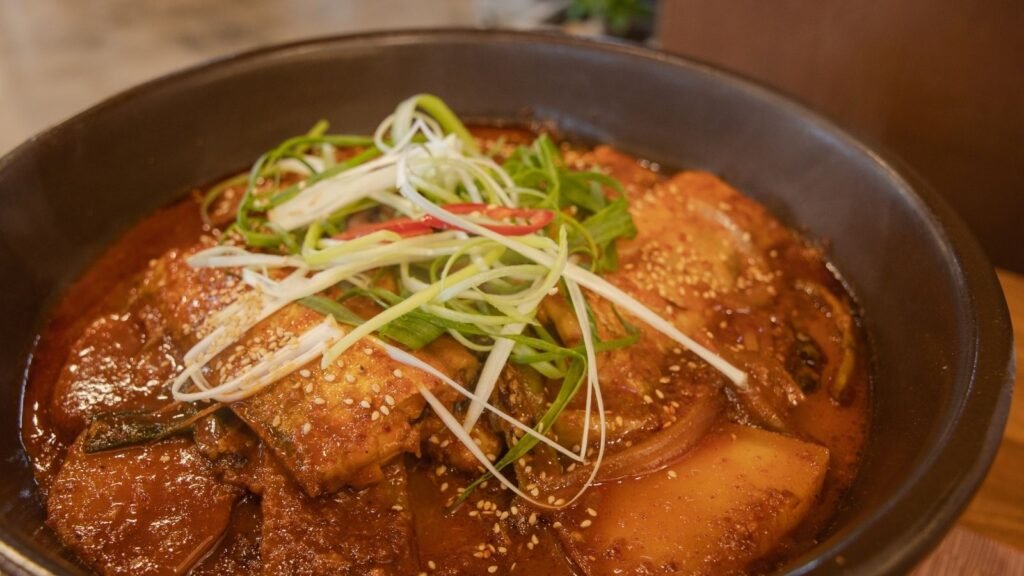
If you only know Korean food through barbecue and fried chicken, you’re missing an entire half of the table. Korean home cooking runs on fish — grilled (gui, 구이), braised (jorim, 조림), and steamed (jjim, 찜) — and almost every Korean household has a rotation of them.
Mackerel gets grilled until the skin blisters. Pollock gets simmered into a clear, peppery stew. Croaker gets salted and dried. Yellow corvina, Spanish mackerel, monkfish, hairtail — the list is long, and each fish has a cooking method it belongs to.
Out of all of them, one is my favorite: galchi (갈치), known in English as beltfish, hairtail, or cutlassfish.
What Is Galchi?
Galchi is a long, ribbon-shaped fish with bright silver skin and no scales — just a fine metallic coating called guanine that gives it a mirror finish. The name comes from the Korean word for “sword” (kal), which is exactly what it looks like: a blade of a fish, sometimes over three feet long.
The flesh is white, soft, and mild, with a clean sweetness and none of the aggressive oiliness of mackerel. That mildness is the point. Galchi doesn’t fight the seasoning — it absorbs it.
Two Ways Koreans Cook It
Galchi gui (갈치구이) — grilled. Salted, pan-fried or grilled until the edges crisp. Eaten with rice, usually nothing else. This is the weeknight version.
Galchi jorim (갈치조림) — braised. Thick cross-cut steaks of galchi simmered in a sauce of gochugaru (Korean chili flakes), soy sauce, garlic, ginger, and often a little rice wine, cooked down slowly in a shallow pot.
Both are good. But galchi jorim is the one I’d order if I could only have one Korean fish dish for the rest of my life.
Why the Radish Is the Real Star
Here’s the part people don’t expect: in a proper galchi jorim, the best bite might not be the fish.
Thick slices of Korean radish (mu, 무) go into the bottom of the pot first. As the dish simmers, the radish soaks up the chili sauce, the soy, and the fish’s own liquid. It goes from crisp and sharp to soft, translucent, and completely saturated with flavor — sweet, spicy, savory, and faintly briny all at once.
Cubes of tofu often join it, doing the same work in a softer register. Some cooks add potato, or lay strips of kimchi or perilla leaves over the top.
By the time the pot comes to the table, you have three textures — flaky fish, silky radish, custardy tofu — sitting in one shared sauce. Spoon that sauce over hot rice and you understand why this dish has a following.
Where Galchi Jorim Is Best in Korea
Seoul has several long-running galchi specialists, many of them clustered in the older downtown neighborhoods, where the dish is served in heavy communal pots meant for sharing.
But the real destination is Jeju Island — often called Korea’s Hawaii. Jeju sits in warm southern waters where galchi is caught by hand-line, one fish at a time, which keeps the skin intact and the silver bright. Fish caught this way is called eun-galchi (은갈치), “silver galchi,” and it’s the premium grade.
On Jeju, entire restaurants are built around this one fish. The galchi arrives thick as your wrist, the flesh nearly gelatinous where it meets the bone, and the radish underneath has been simmering in that sauce for as long as it takes. Eating galchi jorim on Jeju, a few miles from where the fish came out of the water, is one of those meals that recalibrates what you think a dish can taste like.
The Problem With Galchi Jorim in the United States
This is where it gets frustrating.
Finding good galchi jorim in the U.S. is genuinely hard — and the reason usually isn’t the sauce. Korean restaurants here can season a braise correctly. The failure point is almost always the fish itself.
What typically shows up:
- Undersized fish. Thin, narrow galchi cut into pieces that are mostly bone.
- Not enough meat. You spend the whole meal working around a skeleton for very little return.
- Freezer damage. Imported frozen galchi that’s been held too long goes mushy and loses the clean sweetness that makes the fish worth ordering.
When the fish is small and thin, the dish collapses. The whole appeal of galchi jorim is having enough flesh to flake off in substantial pieces and enough fish to flavor the pot underneath it. A skinny galchi can’t do either job.
The One That Gets It Right: Mindeulle
In Southern California, the restaurant I keep going back to for galchi jorim is Mindeulle (민들레), which has two locations:
- Chino Hills — 3330 Grand Ave, Suite G, Chino Hills, CA 91709
- Buena Park / Fullerton area — 8192 Commonwealth Ave, Suite A, Buena Park, CA 90621
Mindeulle is a full-menu Korean restaurant rather than a seafood specialist, but the galchi they use is the right size — thick-cut, with real meat on it — and the braise is done properly, with the radish given enough time to actually turn. The banchan spread is generous, which matters more than people admit with a dish like this, since galchi jorim is a rice-and-side-dishes meal.
What to Know Before You Go
- It isn’t cheap. Galchi jorim is a splurge order at almost any Korean restaurant in the U.S., and this is no exception.
- The portion is built for sharing. One order comfortably feeds two to four people when you’re eating it the intended way — with rice and banchan, not as a solo entrée.
- Go with a group. The price stops feeling steep the moment you divide it three ways.
How to Eat It
If it’s your first time, here’s the order of operations:
- Take a piece of fish and lift the flesh away from the backbone with your chopsticks — it should come off in clean flakes.
- Put it over rice. Add a spoonful of the sauce from the pot.
- Get a piece of the radish. Eat it on its own first, before it’s mixed with anything.
- Keep going. Rotate between fish, radish, tofu, and banchan.
Don’t try to eat around the bones aggressively. Galchi has a simple, orderly skeleton — one spine, ribs off to the sides — and once you find the seam, the meat separates easily.
Frequently Asked Questions
What is galchi in English?
Galchi is called beltfish, hairtail, or cutlassfish in English. It’s a long, silver, ribbon-shaped saltwater fish common in Korean and Japanese cooking.
Is galchi jorim spicy?
Usually, yes. The braising sauce is built on gochugaru and gochujang, so it carries real heat — though it’s a rounded, soy-backed heat rather than a sharp one. Some restaurants will adjust the spice level on request.
What’s the difference between galchi jorim and galchi gui?
Jorim is braised in a seasoned sauce with vegetables. Gui is simply salted and grilled. Jorim is the shared, saucy, rice-forward version; gui is the plain, everyday one.
Why is galchi so expensive?
Line-caught galchi — especially the premium eun-galchi from Jeju — is labor-intensive to catch and easily damaged. Large, thick specimens command a significant premium, and most galchi sold in the U.S. is imported frozen.
Can I make galchi jorim at home?
Yes, and it’s easier than it looks. The main challenge is sourcing: look for the thickest frozen galchi you can find at a Korean grocery store like H Mart, Zion Market, or Hannam Chain, and prioritize width over length.
The Takeaway
Korean fish cookery deserves far more attention than it gets abroad, and galchi jorim is the dish I’d use to make the case. It’s built on one mild, delicate fish and a pot of radish that turns into something entirely different by the end of the cook.
If you’re in Southern California and you want to try it done right, Mindeulle in Chino Hills or Buena Park is where I’d send you. Bring people. Order rice. Don’t skip the radish.


1 thought on “Galchi Jorim: The Korean Braised Beltfish Dish I’d Order Over Anything Else”