Here is the thing that goes wrong with 오징어볶음 (ojingeo bokkeum), and it goes wrong for almost everyone the first few times.
You do everything right. Good sauce, good squid, hot pan. And then somewhere in the last two minutes, liquid starts appearing. Not a little — a genuine pool of pink-orange water at the bottom of the pan. What was supposed to be a glossy stir-fry with sauce clinging to each piece is now squid sitting in soup, and the flavor is diluted, and the squid has gone rubbery besides.
This isn’t a seasoning problem. It’s a water problem, and it’s entirely solvable once you know where the water comes from.
I’ve been making this version, adapted from a recipe by the Korean chef Jung Ho-young, and it fixes the issue with two changes to the order of operations. It also uses a lot of buchu, the flat Korean chives that are cheap at any Asian market, take thirty seconds to cook, and turn this from a stir-fry into something that feels like an actual balanced dinner.
Where the water comes from (and how to stop it)
Squid is mostly water, and it releases that water when it’s heated too long or too gently. Onions do the same thing. Once the liquid is out, it’s out — you can’t reabsorb it, you can only boil it away, and by the time you’ve done that the squid is overcooked.
So the entire technique is about not letting it out in the first place:
1. Pat the squid dry. Especially if it was frozen. Paper towels, both sides, be thorough. This alone makes a visible difference.
2. Get the pan genuinely hot. Higher than feels comfortable. Water evaporates on contact instead of pooling.
3. Cook the vegetables first, and add the squid near the end. This is the change that matters most. The squid should be in the pan for two to three minutes, total. Not five. Not “until it looks done.”
4. Never cover the pan. A lid traps steam and steam is water.
5. Don’t crowd it. Too much in the pan drops the temperature and everything starts to simmer instead of sear. Use a wide skillet, or cook in two batches.
There’s a well-known rule about squid: cook it for three minutes or thirty minutes, nothing in between. The short window keeps it tender. The long one breaks it down into tenderness again. The middle is where rubber lives, and a stir-fry has no business being there.
Why so many chives
부추 (buchu) are simply labeled chives at H Mart and most Asian markets. They’re flat green blades, sold in big bunches for a couple of dollars, with a flavor somewhere between onion and garlic. Korean cooking uses them constantly.
One thing to watch: these are not the thin, hollow chives sold as a fresh herb in a small plastic clamshell at American supermarkets. Those are a different plant, sold in tiny quantities, and they won’t work here. What you want is the full bunch from the Asian market — you may also see them labeled Chinese chives or garlic chives, which is the same thing.
I use a lot of them, more than most recipes call for, and there are two reasons:
They make it a real meal. A big handful of greens folded in at the end turns a plate of squid and sauce into something with actual substance and nutrition behind it. They bring fiber, vitamin A, vitamin C, and vitamin K, and they cost almost nothing.
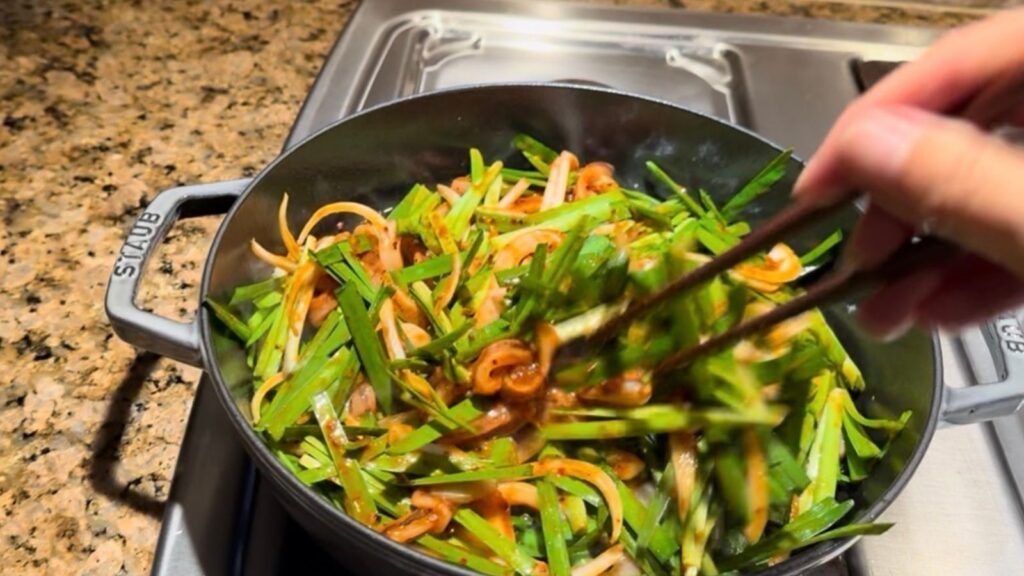
They cook in thirty seconds. This is the practical part. You add them at the very end, off the heat or nearly, and they wilt just enough to soften while staying bright green and slightly crisp. They don’t release water into the pan the way spinach or cabbage would. They’re the ideal green for a dish where water is the enemy.
Can’t find them? Use the green tops of scallions, cut into 2-inch lengths, added at the same point. It works, but buchu is great too.
Ingredients (serves 2–3)
The main event:
- 1 lb (about 450g) cleaned squid, bodies and tentacles
- 1 large bunch chives (부추 buchu), about 4 oz, cut into 2-inch lengths
- 1 medium onion, sliced — not too thin
- 1 large scallion, cut into 2-inch pieces
- 1 Korean green chili or jalapeño, sliced (optional)
- 1 Tbsp neutral oil
Sauce — mix in a bowl first:
- 1½ Tbsp gochujang
- 1 Tbsp gochugaru
- 1 Tbsp soy sauce
- 1 Tbsp oyster sauce
- 1 Tbsp sugar
- 1 Tbsp mirin or rice wine
- 1 Tbsp minced garlic
To finish:
- 1 Tbsp toasted sesame oil
- 1 Tbsp toasted sesame seeds
About the squid
Frozen cleaned squid is completely fine here — arguably better, since it’s usually frozen at sea. Look for squid tubes and tentacles in the freezer at H Mart, or the calamari at Trader Joe’s, or the frozen seafood section of any regular supermarket. Thaw it, drain it, and dry it well.
Score it if you have two extra minutes. Cut shallow crosshatch lines into the inside surface of the squid bodies before slicing them into pieces. It’s a small step that does two things: the sauce grips the scored surface instead of sliding off, and the pieces curl attractively as they cook. This is a chef’s move and it’s genuinely worth it.
Instructions
1. Mix the sauce. All seven ingredients in a small bowl, stirred smooth. Set aside.
2. Prep everything. Score and cut the squid, slice the onion, cut the buchu and scallion. Pat the squid dry. Once the pan is hot, this dish moves fast and there’s no time to be chopping.
3. Heat the pan hard. Wide skillet or wok, high heat, 1 Tbsp oil. Wait until it’s shimmering.
4. Onion and scallion, 1 minute. Just until they start to soften at the edges. Keep them moving.
5. Add the sauce and let it fry for about 30 seconds. This is a small step that makes a real difference — cooking the gochujang and gochugaru in the hot oil for a moment deepens the flavor and takes the raw edge off the chili paste. You’ll see the oil turn red.
6. Squid in. High heat. 2–3 minutes. Stir constantly. The squid will turn opaque and firm up and curl. Stop there. The moment it’s opaque, it’s done — anything past that and you’re on the wrong side of the three-minute rule.
7. Kill the heat. Chives in. Add the buchu and the optional chili and toss them through the residual heat for about 30 seconds. They should wilt but stay green.
8. Sesame oil and sesame seeds, off the heat. Toss once and serve immediately.
How to eat it
Over hot rice is the default, and it’s excellent — this is properly a 밥도둑, a “rice thief.”
But the better move, and the one I’d actually recommend: over cold somyeon noodles. Boil thin wheat noodles, rinse them under cold water until they’re properly cold, drain hard, and pile the hot squid on top. The temperature contrast is the whole point and it’s one of my favorite summer meals.
It’s also a very good drinking dish. Spicy, savory, a little sweet — it goes with beer and soju the way it’s supposed to.
Troubleshooting
It went watery anyway. The pan wasn’t hot enough, or the squid was wet, or it was in there too long. Those are the three, in order of likelihood.
The squid is rubbery. Overcooked. Two to three minutes, no more.
It’s too spicy. Cut the gochugaru to half. The gochujang is doing most of the flavor work anyway.
It’s not spicy enough. Add a sliced Korean green chili with the chives, or another teaspoon of gochugaru.
The sauce is too thick and sticky. A tablespoon of water at the end, tossed through, loosens it without watering it down.
Frequently asked questions
Can I use frozen squid without thawing? No — it’ll release all its water into the pan. Thaw completely, drain, and dry.
Can I substitute shrimp or octopus? Yes. Shrimp works beautifully with the same timing. Octopus needs to be pre-cooked. Nakji bokkeum, made with small octopus, is the well-known cousin of this dish.
What can I use instead of oyster sauce? More soy sauce plus a pinch of sugar. Or leave it out — the dish loses a little depth but works.
Is this gluten free? Not usually. Gochujang and soy sauce typically contain wheat. Use gluten-free versions of both and skip the oyster sauce or use a GF one.
Where do I buy buchu? H Mart or any Asian market, in the produce section, sold in bunches and usually labeled just “chives.” They wilt fast, so use them within a few days.
Can I make it ahead? Not really. Squid firms up and the chives lose their color. This is a fifteen-minute dish for a reason.
A note on this recipe
This is adapted from a version by Jung Ho-young (정호영), a Korean chef known for exactly this kind of cooking — quick, well-balanced home recipes with a clear technical logic underneath them. His original is a lean dish of squid, onion, and scallion, and the sauce ratios here are close to his.
The change I’ve made is the buchu, and a lot of it. His version is more restrained; mine turns it into something closer to a complete dinner, which is what I actually want on a weeknight. If you’d rather have the cleaner original, just leave them out and add a second onion.
Made it without the puddle? That’s the whole test. Tell me how it went. @season.of.seoul