Every Korean soup and stew starts in the same place: 육수 (yuksu), the broth. Dried anchovies, a piece of kelp, a chunk of Korean radish, sometimes dried shiitake. Simmer, strain, and you have the savory foundation that everything else sits on.
It is not hard. It is also not fast, and it produces a colander of soggy anchovies and limp kelp that goes straight in the trash. Every single time.
My mother made stock this way for decades. She taught traditional Korean cooking for a living, so of course she did. And I want to be respectful about this — that stock is better. I’m not going to pretend otherwise.
But I make dinner on a Tuesday after a full workday, and I have coin broth, and I use it, and my food tastes good. So let’s talk about it honestly.
What coin broth is
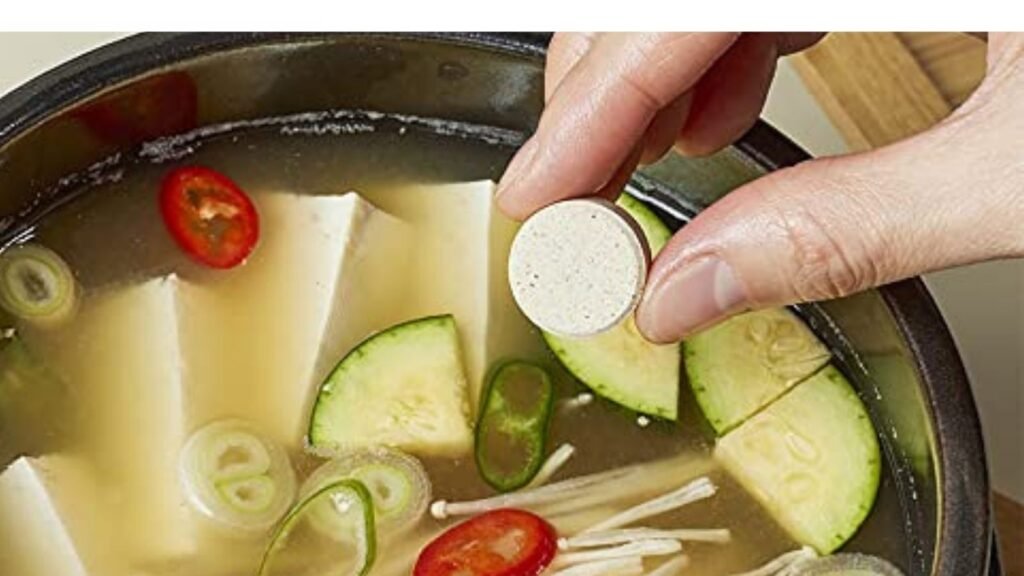
육수코인 (yuksu coin) is exactly what it sounds like: concentrated broth compressed into a small tablet about the size of a coin, individually wrapped. Drop one into hot water, stir for a few seconds, and you have anchovy-kelp stock. There are powdered versions too, sold in stick packs, which work the same way.
That’s the whole product. There’s no trick to it.
What it replaces is roughly this: buying dried anchovies, cleaning them (you’re supposed to remove the heads and guts or the broth goes bitter), simmering for thirty to forty minutes, straining, and then throwing away a pile of wet, heavy, smelly waste.
The food waste piece is a real benefit, not just a convenience one. A bag of dried anchovies is mostly destined for the garbage — you extract the flavor and discard the fish. Coin broth eliminates that entirely. If you cook Korean food a few times a week, that adds up.
An honest note about quality
I want to be straight with you, because I think it makes the recommendation more useful.
The early versions of these were not good. When they first showed up, a lot of them tasted flat and aggressively salty — you could tell you were eating a shortcut. I tried a few, wasn’t impressed, and went back to making stock.
What changed is competition. Enough brands entered the category that they had to actually improve, and over the past several years the quality has climbed steadily. The good ones now taste like broth rather than like bouillon. They’re not identical to a pot of real anchovy stock — a careful cook will notice — but the gap has narrowed to the point where, for weeknight cooking, it doesn’t meaningfully change the dish.
That’s a real shift, and it’s why I use them now when I didn’t five years ago.
Three that are worth buying
All three are on Amazon, which is the main reason I’m recommending these specifically — a lot of good Korean brands never make it here, and there’s no point telling you about something you can’t get.
1. Secret Coin (시크릿코인)
The one I reach for most. Balanced and mild — it does what a base is supposed to do, which is add depth without announcing itself. If you want a general-purpose stock that disappears into whatever you’re cooking, start here.
[Secret Coin broth stock, Amazon]
2. Jwellfood Anchovy Broth Tablets (명품한알)
Straightforward Korean anchovy stock, made in Korea, individually wrapped, twenty tablets of 3g each in a pack. Around 8 calories a tablet. This is the most traditional-tasting of the three — noticeably anchovy-forward, which is exactly what you want in a kimchi jjigae or a doenjang stew.
[Jwellfood anchovy broth tablets, Amazon]
3. Vegetable Broth Coins
The vegetarian option, built on vegetables and usually kelp rather than fish. If you don’t eat seafood, this is what makes Korean stews possible for you — most Korean soup bases are anchovy-based, so a vegetable version isn’t a minor variation, it’s the difference between cooking this food and not.
Also useful if you’re cooking for a mixed table.
[vegetable broth coins, Amazon]
How to use them
The ratio: generally one tablet per 2 cups (about 500ml) of water. Check your package — concentration varies by brand — but that’s the standard starting point.
When to add it: into the water as it heats, before anything else goes in. It dissolves in seconds.
What to use it in:
- Doenjang jjigae and kimchi jjigae — the most obvious use, and the biggest improvement over plain water
- Miyeok-guk, seaweed soup
- Sundubu, soft tofu stew
- Guksu, any Korean noodle soup
- Tteokbokki — use broth instead of water for a deeper sauce (my market-style recipe)
- Steamed egg — replace the water with broth and it’s a different dish
- Braises and stir-fries, anywhere you’d otherwise splash in water
One thing to watch: salt. These are seasoned, and some are quite salty. Season your dish at the end, after the broth is in, not before. This is the single most common mistake, and it’s why some people conclude the product tastes too salty when really they just salted twice.
When I still make real stock
I don’t want to oversell this. There are times the shortcut isn’t the right call:
- When the broth is the dish. A clear soup where you’re tasting the stock directly — seolleongtang, a delicate guksu — deserves the real thing.
- When you’re cooking for guests and you have the time. It’s a different level, and people notice.
- When you want to control the salt completely. Homemade stock has none until you add it.
For everything else — which is most of what I actually cook — the coin goes in the pot and dinner happens.
Frequently asked questions
Do coin broth tablets contain MSG? Many do; some are labeled MSG-free. Check the specific product if it matters to you. Worth knowing that MSG is naturally present in kelp and anchovies too — it’s the compound that makes them taste savory in the first place.
How long do they keep? A year or more, sealed, at room temperature. Individually wrapped tablets are more shelf-stable than an opened bag of dried anchovies, which is another small argument for them.
Coins or powder? Coins are pre-portioned, which makes them easier to use consistently. Powder is more flexible if you want to fine-tune. Same product, different format.
Can I use these instead of dashi? They’re similar in spirit but not the same — Korean anchovy stock is deeper and less smoky than Japanese katsuo dashi. You can substitute in a pinch, and the result will simply taste Korean.
Is it cheaper than making stock? Roughly a wash. You’re buying time and a clean kitchen, not savings.
Are they gluten free? Usually not — many contain wheat-derived ingredients. Read the label.
What’s your shortcut you’re not sorry about? I’d like to hear it. @season.of.seoul