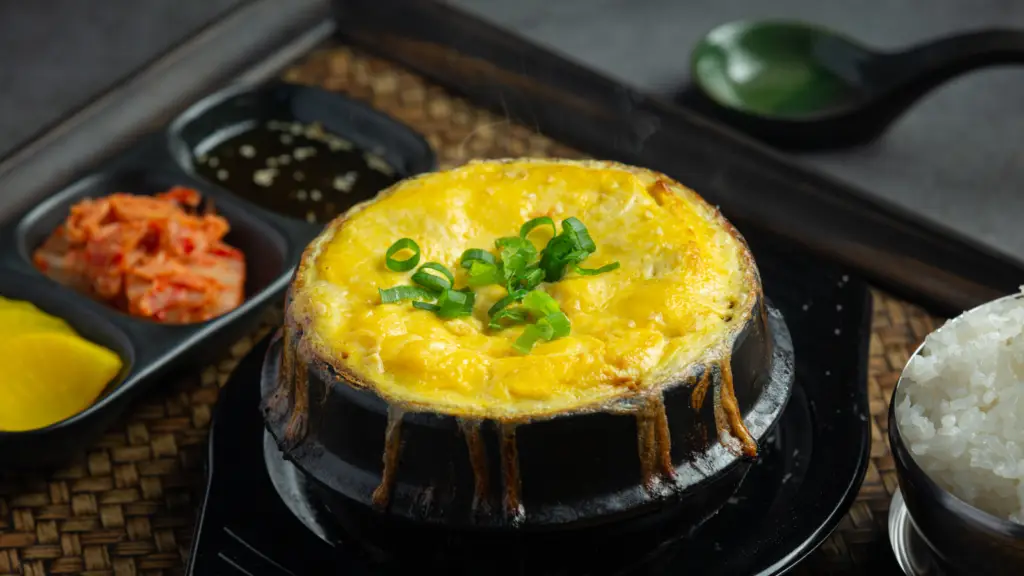
If you’ve ever sat down at a Korean BBQ restaurant, you’ve seen it arrive: a small black clay pot, still bubbling, with a golden dome of egg rising up and over the rim like a soufflé that got away with something. Everyone at the table looks. Someone takes a picture.
In Korean it’s called 폭탄계란찜 (poktan gyeran-jjim) — literally “bomb steamed egg,” because of the way it erupts out of the pot. And for years I assumed it was restaurant magic. Something that required a professional burner, or a technique my mother never got around to teaching me.
It isn’t. It’s six eggs, a little water, and one rule about how full you fill the pot.
I grew up in Seoul with a mother who taught traditional Korean cooking for a living, and somehow this was never on our table — it’s more of a restaurant dish than a home dish in Korea. I learned it the way most people do now: by watching it happen in front of me at a barbecue place and going home determined. It took me three tries to get the dome. It’ll take you one, because I’m going to tell you the part nobody mentions.
Why this recipe earns its place in your rotation
It’s a protein bomb. Six large eggs is about 36 grams of protein. Split into two servings, that’s 18 grams each for roughly 220 calories. That’s a better protein-to-calorie ratio than most of the “high protein” things I paid money for last year.
It looks like a bomb. The dome is genuinely dramatic. This is a five-ingredient dish that photographs like you tried very hard.
And it tastes like one too. Silky, warm, deeply savory — the texture lands somewhere between a French custard and the softest scrambled eggs you’ve ever made. It’s comfort food that happens to be almost pure protein.
Serve it next to rice the way Korean restaurants do, and it’s the perfect side. But here’s my favorite thing about it: if you’re cutting carbs, skip the rice entirely and eat it on its own. It’s rich enough and filling enough to be the whole meal. I eat it straight out of the pot on nights when I want dinner to be over in fifteen minutes and still feel like I ate something real.
What you need (and where to get it)
The pot
A ttukbaegi (뚝배기) is a Korean earthenware pot — thick, dark, unglazed on the outside. It’s the reason this dish works. Clay holds and radiates heat far more evenly than thin metal, which is what builds the steam that pushes the egg up. It also keeps the whole thing volcanically hot at the table for a good ten minutes after you turn off the stove.
Where to buy one: Any H Mart carries them in the housewares aisle, usually $12–25 depending on size. They’re also easy to find on Amazon — search “ttukbaegi” or “Korean earthenware pot.” For this recipe you want a 16–20 oz (about 500–600 ml) pot, the small single-serving size. Bigger pots are for stews.
No ttukbaegi? A small cast iron pot or any thick-bottomed saucepan with a well-fitting lid will get you most of the way there. The dome will be shorter and it’ll cool faster, but the taste is identical. Thin nonstick pans are the one thing I’d avoid — they scorch the bottom before the top has a chance to rise.
The ingredients
- 6 large eggs
- ½ cup water — or chicken broth, or Korean anchovy broth if you want more depth
- ½ teaspoon salt
- 1 tablespoon toasted sesame oil, plus a little more for brushing the pot
- 2 scallions, finely chopped
- Toasted sesame seeds and black pepper, to finish
That’s the whole list. Everything except the sesame oil is already in your kitchen, and toasted sesame oil is at every regular American grocery store now.
One optional upgrade: Korean cooks often season this with saeujeot (salted fermented shrimp) instead of plain salt — about 1 teaspoon, minced. It adds a savory depth that salt alone can’t. You’ll find it in a small jar in the refrigerated section at H Mart. Not essential. Very good.
How to make it
1. Whisk the eggs. Beat the eggs with the salt, water, and half the scallions until completely smooth and uniform in color. If you want a silkier result, pour the mixture through a fine strainer — it catches the chalazae (those white stringy bits) and takes about ten seconds.
2. Brush the pot with sesame oil. Coat the inside of the ttukbaegi, all the way up the walls. This keeps the egg from welding itself to the clay, and it adds a nutty aroma as it heats.
3. Fill the pot only 70–80% full. This is the rule. This is the entire secret. The egg needs empty space above it to climb into. Fill it to the brim and it will simply boil over the sides and down onto your stove instead of doming up. If you have extra egg mixture, save it — don’t force it in.
4. Stir over medium-low heat. Put the pot on the burner and stir constantly with a spoon, working from the edges inward and scraping the bottom. Keep going for 4–5 minutes, until the eggs stop being liquid and start forming soft, cloudy curds — it should look like loose scrambled eggs. Don’t walk away here. The bottom will scorch if you do.
5. Lid on, heat to low. Scatter the remaining scallions over the top, cover the pot, and turn the heat down to low. Give it 2–3 minutes. Inside, steam is building with nowhere to go, and it lifts the whole thing up into the dome.
6. Turn off the heat and wait one minute before you lift the lid. This last rest is what sets the top so the dome holds its shape instead of collapsing the second air hits it.
Finish with sesame seeds, a small drizzle of sesame oil, and bring the pot straight to the table.
Troubleshooting
It didn’t puff. You filled the pot too high, or your lid doesn’t seal well. Try 70% next time and press the lid down firmly.
The bottom burned. Your heat was too high during the stirring stage, or you stopped stirring. Medium-low, and keep the spoon moving.
It came out rubbery. Overcooked. The dish keeps cooking in the residual heat of the clay after you turn off the stove, so pull it a touch earlier than feels right.
It collapsed immediately. You lifted the lid too soon. That one-minute rest matters.
Ways to change it up
- Add cheese. A handful of shredded mozzarella stirred in at step 4 is not traditional at all and is absolutely delicious.
- Make it spicy. A teaspoon of gochugaru (Korean chili flakes) in the egg mixture.
- Add vegetables. Finely diced carrot, mushroom, or zucchini, stirred in early so they soften.
- Make it a meal. Add a handful of chopped shrimp or crab meat. Protein on protein.
Frequently asked questions
Can I make this in the microwave? You can make a decent steamed egg in the microwave, but you won’t get the dome — the puff comes from sustained trapped steam in a heavy pot. Different dish, same family.
Is a ttukbaegi safe on an electric or induction stove? On electric coil and glass-top, yes — heat it gradually and never put a cold wet pot on a hot burner. Clay cracks from thermal shock. On induction, no; clay isn’t magnetic. Use cast iron instead.
How do I clean a ttukbaegi? Warm water and a brush. Skip the soap — unglazed clay is porous and absorbs it. Let it dry completely before storing.
How many people does this serve? Two as a side dish, or one very satisfying dinner if you’re eating it without rice.
Can I make it ahead? This one’s worth making fresh. It’s ten minutes, and the dome is the entire point.
If you make this, I’d love to see the dome. Tag me @season.of.seoul.