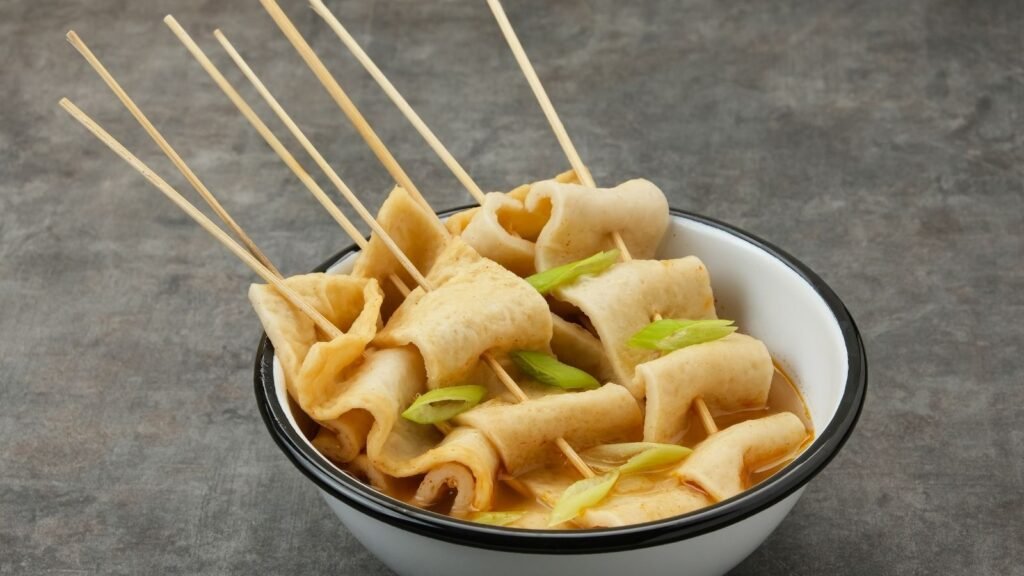
There’s a paper cup of hot broth that comes free with Korean street food in winter. You stand at the cart, pull a skewer of fish cake out of the simmering pan, and refill the cup as many times as you want while you eat. Nobody charges for it. It’s one of the small, unspoken generosities of Korean street life.
The thing on the skewer is eomuk (어묵). A lot of English-language menus call it odeng, and a lot of Koreans say odeng too. But the word is Japanese, and it doesn’t mean what most people think it means.
Odeng, Eomuk, Tempura: Three Words, Three Things
Odeng comes from the Japanese oden (おでん). In Japan, oden isn’t a fish cake — it’s a dish: a pot of dashi broth with daikon, boiled eggs, tofu pockets, konjac, and fish cakes among the things simmering in it. The fish cake is one ingredient in oden, not the name of the ingredient.
Eomuk (어묵) is the Korean word for the food itself: fish flesh ground to a paste, mixed with other ingredients, then shaped and cooked until it sets. That’s it. That’s the definition.
Tempura (tempura) is a third thing entirely — fish or vegetables coated in batter and fried, which is Japanese but unrelated. It shows up in this conversation because some older Korean fish cake shops still use the word for their fried products, which confuses everyone.
Korea’s National Institute of Korean Language has pushed eomuk as the standard term for decades. Older Koreans still say odeng out of habit. Younger ones increasingly don’t. If you’re writing a menu or a recipe, eomuk is the word.
Why Busan
Fish cake arrived in Korea through Busan, and it stayed there.
The geography explains most of it. Busan is Korea’s biggest port and the closest major city to Japan, so Japanese food processing techniques landed there first. It also had what a fish cake industry actually needs: boats coming in daily with fish too small or too bony to sell whole.
That last part is the interesting bit. Early Busan fish cake wasn’t made from premium fish. It was made from pulchi (풀치) — juvenile beltfish, the same species that grows up to become the galchi in a braising pot [/galchi-jorim-korean-braised-beltfish/] — and kkangchi (깡치), juvenile croaker. Fish nobody could sell at market, ground into a paste and fried into something people would pay for. It was a poverty food that became an industry.
The factories clustered near the fish markets so the catch wouldn’t sit. Through the 1950s and 60s, shop after shop opened: Hwangong in Bupyeong Market, Samjin in Yeongdo’s Bongnae Market in 1953 — still the oldest surviving fish cake maker in Korea — then Mido, Yeongjin, Hyoseong, Daewon, and Goraesa in Bujeon-dong in 1963.
Busan still produces more fish cake than anywhere else in Korea and holds well over 30% of the national market. Ask a Korean where good fish cake comes from and the answer is one word.
The Busan eomuk label problem.
Here’s a wrinkle that Busan natives find funny and slightly insulting.
Busan eomuk became a nationwide street-food selling point in the 1990s.
Moreover, when Seoul cart vendors began advertising it to justify raising prices, the label spread quickly.
Much of what was sold under it had never been near Busan.
This result is a running joke. However, Busan native buys Busan eomuk from a cart in another city, bites it, and tastes mostly wet flour. That is what cheap fish cake is— mostly flour, with enough surimi to make the claim.
Which brings us to what actually separates good fish cake from bad.
Flour Is the Dividing Line
Every fish cake contains some starch. It’s a binder, and without it the paste won’t hold. The question is how much, and what else is in there.
Cheap fish cake leans on wheat flour and starch to fill volume, because flour is far cheaper than fish. It bloats in broth, goes soft and pasty, and tastes like the seasoning rather than the fish.
Good fish cake keeps the flour minimal and lets the fish content carry the product. It stays springy after a long simmer instead of turning to mush. It tastes like fish — clean and slightly sweet, not fishy. And the texture has a specific bounce that Koreans describe as jjonddeut-hada (쫀득하다), somewhere between chewy and elastic.
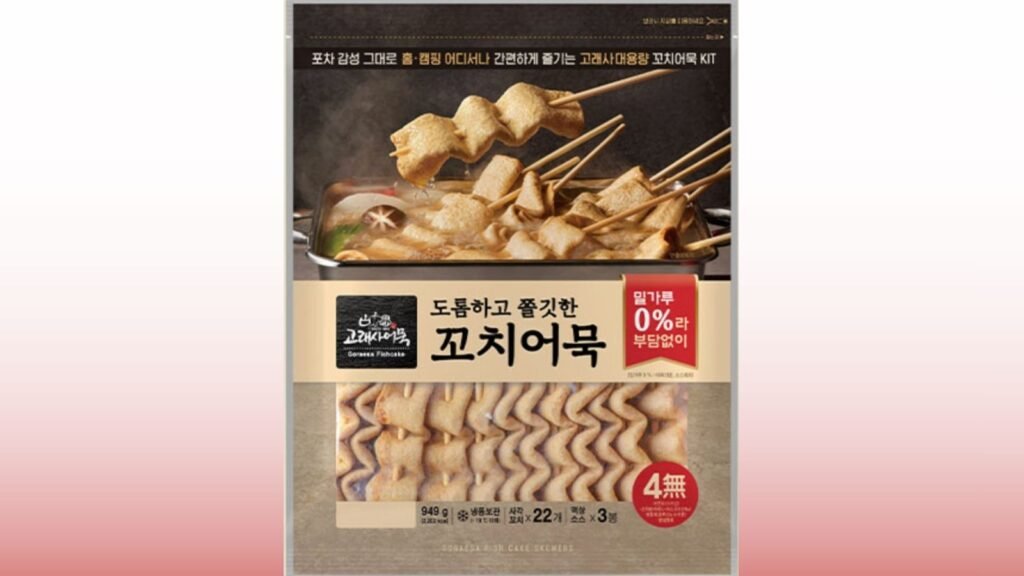
That difference is what the premium Busan brands built their businesses on. Samjin blends high-grade Alaska pollock with threadfin bream. Goraesa, whose name (古來思) carries the sense of gratitude to longtime customers, has run since 1963 on the position that fish cake deserves to be treated as a real dish rather than a filler — minimal flour, high fish paste content, and some lines made with pollock alone.
The trade-off is real, and not everyone likes it. Premium fish cake holds its shape stubbornly. Plenty of older Koreans prefer the old street version — soft, swollen with anchovy broth, falling apart a little. That’s the taste they grew up with, and springy premium fish cake doesn’t scratch that itch.
The Fish Cake Bakery
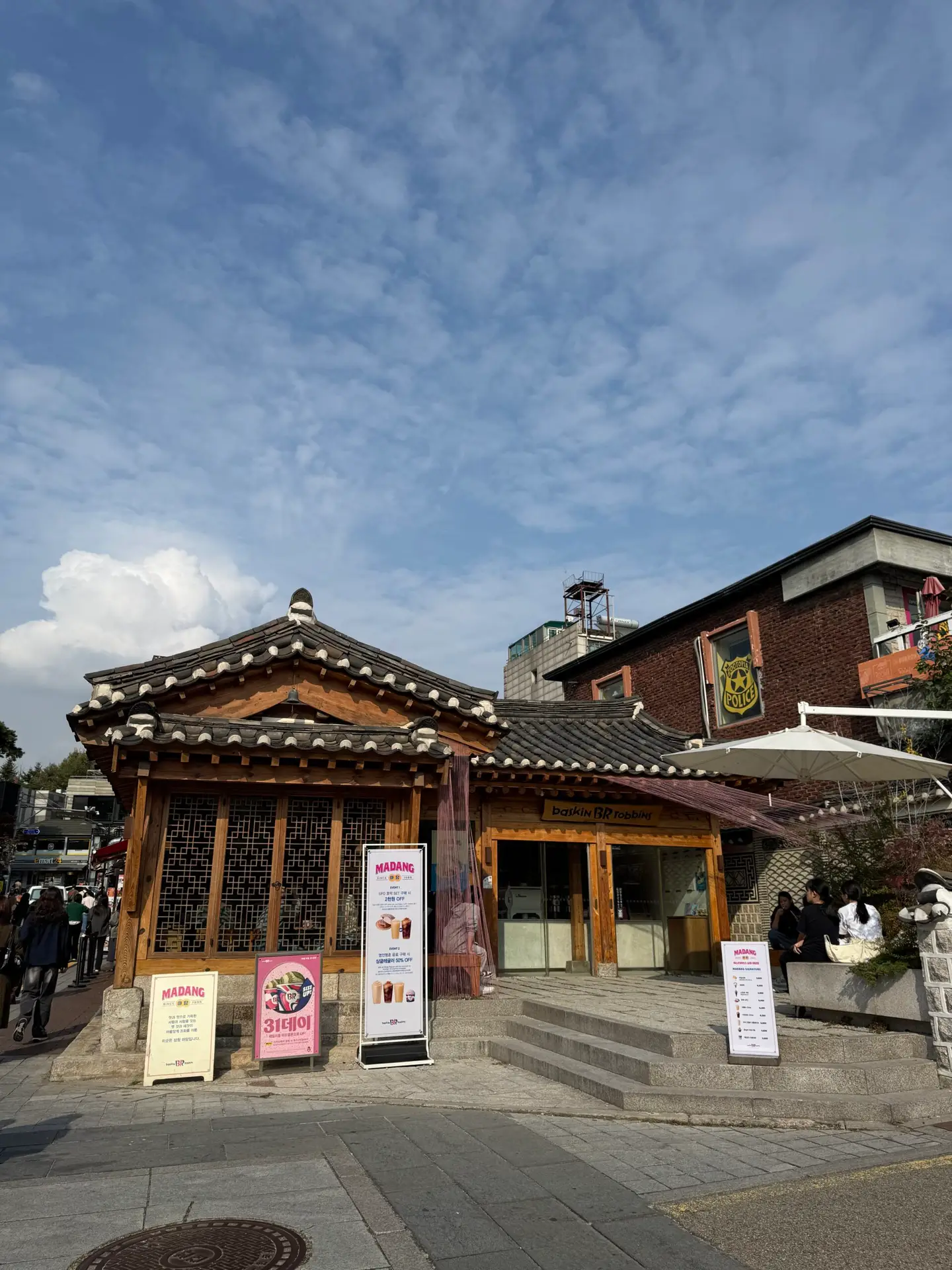
In 2013, Samjin opened a fish cake shop in Busan built like a European bakery — glass cases, trays, tongs, warm product coming out continuously. It sold fish cake croquettes, fish cake stuffed with cheese, fish cake shaped into baguettes.
It worked far better than anyone expected. The Yeongdo location became a tourist destination, drawing crowds in the millions, and the format spread. Fish cake bakeries and fish cake cafés opened across Busan. Department stores in Seoul added counters. Goraesa built out its own premium range, including yonggung-eomuk served sliced like sashimi and a line meant to be paired with wine.
A food that started as a way to use up unsalable fish now sits in department store food halls at premium prices. That’s a fairly complete reversal in about seventy years.
How Koreans Actually Eat It
Eomuk-tang / odeng-tang — skewers simmered in anchovy-kelp broth. Street carts in winter, with soy dipping sauce and that free cup of broth.
In tteokbokki — flat sheets cut into triangles, cooked in the chili sauce alongside the rice cakes. Non-negotiable.
Eomuk bokkeum — cut into strips and stir-fried with soy sauce, garlic, and sesame oil. One of the most common banchan in a Korean lunchbox, hot or cold.
In gimbap — a strip of seasoned fish cake running down the roll.
In kimchi jjigae and budae jjigae — added late for texture.
It’s a weekday food. It’s cheap, it keeps, it needs no preparation, and it goes in almost anything. Most Korean households have a bag in the freezer at all times, and most Korean kids have eaten it several times a week without ever thinking about it.
If You’re Buying It in the U.S.
The gap between good and bad fish cake is wide, and the label tells you which one you’re holding — if you know what to read. I’ve written a separate guide to that: How to Buy Korean Fish Cake: A Grocery Guide [/korean-fish-cake-buying-guide/].
Short version: check the fish content percentage, look at where flour and starch sit in the ingredient list, and if your market carries Goraesa or Samjin, start there.
Frequently Asked Questions
Is odeng Korean or Japanese?
The word is Japanese. In Japan, oden refers to a simmered hot pot dish, not to fish cake. Koreans borrowed the word during the colonial period and applied it to the fish cake itself. Eomuk is the Korean term and the recommended one.
What is Korean fish cake made of?
Ground white fish — usually Alaska pollock, threadfin bream, or a blend — mixed with starch, seasoning, and sometimes vegetables, then shaped and fried or steamed. The proportion of fish to starch is what separates cheap from good.
Is eomuk the same as imitation crab?
Same family. Both are surimi products. Imitation crab is fish paste shaped and colored to mimic crab leg, usually with no crab in it at all.
Why is Busan famous for fish cake?
It was Korea’s main port and the closest major city to Japan, so the technique arrived there first, and the local fishing industry supplied a steady stream of small fish that had no other market. The industry has stayed concentrated there ever since.
Does eomuk taste fishy?
Good fish cake doesn’t. It’s mild and slightly sweet. Fish cake that tastes strongly fishy is usually a sign of low-quality or poorly handled surimi.
Fish cake is one of the easiest entry points into Korean food, and one of the most underrated. If your only experience is the rubbery pieces floating in tteokbokki
from a mediocre takeout order, the good version is a different food entirely.
1 thought on “Eomuk, Not Odeng: The Ultimate Fish Cake City”