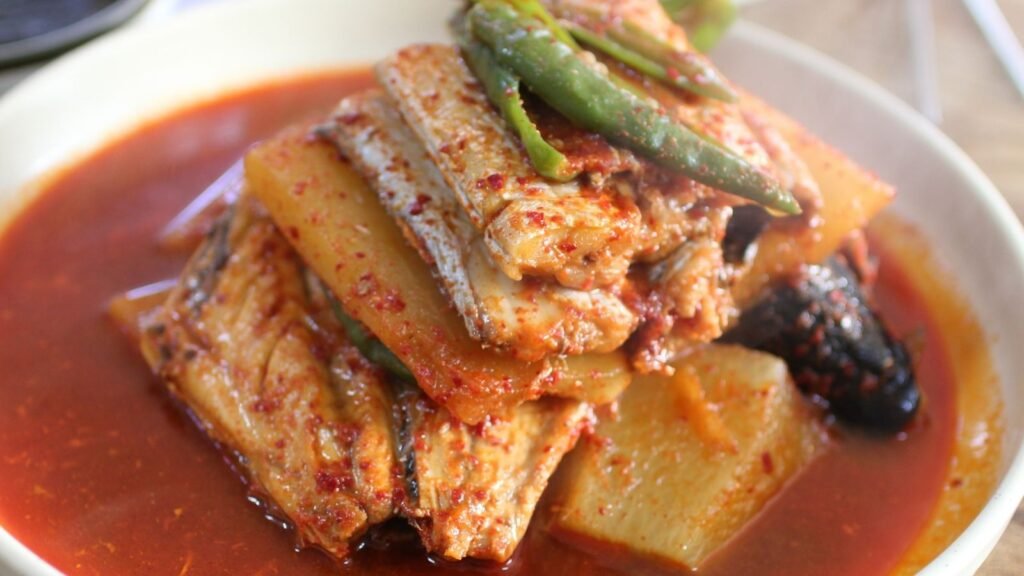
Galchi jorim is one of those Korean dishes that looks like it should be difficult and isn’t. One pot, one layer of vegetables, one spoonable sauce, about thirty-five minutes start to finish. The technique is simple: you stack everything in a shallow pot, pour the sauce over, and let it cook down without stirring.
The result is a pot of spicy, savory braised fish sitting on top of radish and potato that have soaked up everything around them. It’s a rice dish above all else — the sauce is meant to be spooned over a hot bowl.
If you want the background on the fish itself and where to eat this dish out, I wrote about that separately: Galchi Jorim: The Korean Braised Beltfish Dish I’d Order Over Anything Else.
Why This Recipe Works
- Rice wine marinade. Ten minutes in cheongju (Korean clear rice wine) and salt strips out the faint metallic edge that frozen fish can carry. Skip it and you’ll taste the difference.
- Broth coins instead of plain water. Korean broth coins (코인육수) are compressed tablets of anchovy, kelp, and dried vegetables. One drops into hot water and dissolves in about a minute, giving the sauce the savory backbone that soy sauce alone can’t provide — without simmering a stockpot first.
- Layering, not stirring. Onion on the bottom, then the root vegetables, then the fish on top. Galchi is delicate. If you stir it, you’ll end up with shredded fish in chili sauce.
- Lid off, heat high. The sauce needs to reduce and concentrate. A covered pot steams instead of braising and you’ll finish with a thin, watery sauce.
Ingredients
Serves 3–4 with rice and banchan · Prep 15 min · Cook 25 min
Main
- 1 whole galchi (beltfish/hairtail), about 1½ lb / 700 g, cleaned and cut crosswise into 5 pieces
- 2 medium potatoes (Yukon Gold works well), peeled, cut into ½-inch / 1 cm rounds
- 8 oz / 250 g Korean radish (mu), peeled, cut into ½-inch half-moons — see the radish note below
- 1 medium onion, sliced thick
- 1 large scallion or daepa, cut on a sharp diagonal
- 1 red chili and 1 Korean green chili (cheongyang), sliced on a diagonal
- 1½ cups / 360 ml water + 1 Korean broth coin — increase to 3 cups / 720 ml water + 2 coins if you’re using radish
- Optional: 7 oz / 200 g firm tofu, cut into ¾-inch slabs
Fish marinade
- 1 Tbsp cheongju (Korean rice wine) or dry sake
- 1 pinch salt
Braising sauce
- 4 Tbsp soy sauce
- 3 Tbsp gochugaru (Korean chili flakes)
- 2 Tbsp mirin or Korean cooking wine (matsul)
- 1 Tbsp minced garlic
- 1 Tbsp ginger juice (or 1 tsp finely grated fresh ginger)
- 1 Tbsp sugar
- Black pepper, to taste
About the broth coins
Korean broth coins go by several names in English — broth tablets, stock coins, soup stock tablets — and by 코인육수 or 동전육수 in Korean. Most are about 4 g each and are dosed at one coin per 1¼–1½ cups (300–360 ml) of water. Anchovy-and-kelp (멸치디포리) is the right flavor for this dish; the beef-bone (사골) version is not.
They’re sold at H Mart, Zion Market, Hannam Chain, and most Korean groceries, and they’re widely available on Amazon.
One important note: broth coins are already salted. Start with 3½ Tbsp of soy sauce instead of 4, taste the sauce partway through, and add the rest only if it needs it. Brands vary a lot in saltiness.
Instructions
1. Make the broth (2 minutes)
Bring 1½ cups of water to a boil, drop in 1 broth coin, and stir for about a minute until it fully dissolves. Set it aside.
That’s the whole step. You can also skip the pre-dissolving and drop the coin straight into the pot with the water in step 5 — it will break down as the braise comes up to heat. Dissolving it first just makes it easier to taste the base before you commit.
2. Prep the fish (10 minutes, mostly waiting)
Remove the innards and any dark membrane inside the cavity, then rinse the fish well under cold water. Cut it crosswise into 5 pieces.
If the silver coating looks patchy or you find the texture unpleasant, scrape it off gently with the back of a knife — it’s edible either way, and most Korean cooks leave it on.
Toss the pieces with the cheongju and a pinch of salt and let them sit for 10 minutes while you prep everything else.
3. Cut the vegetables
Slice the potatoes into ½-inch rounds. Cut the onion into thick slices. Slice the scallion and both chilies on a sharp diagonal — set the scallion and chilies aside separately, since they go in at the end.
4. Mix the sauce
Combine the soy sauce, gochugaru, mirin, garlic, ginger juice, sugar, and black pepper in a small bowl. Stir until the chili flakes are fully wet and there are no dry clumps.
5. Layer the pot
Use a wide, shallow pot rather than a deep one — you want the fish in a single layer.
Onion goes on the bottom. Potatoes on top of the onion. Fish on top of the potatoes, skin side up. Pour the sauce evenly over everything, then add the broth around the edges of the pot rather than directly over the fish, so you don’t wash the seasoning off.
6. Braise, uncovered (10–15 minutes)
Bring it to a boil over high heat and leave the lid off. Don’t stir. As the liquid reduces, tilt the pot slightly and spoon the sauce from the bottom back over the fish every few minutes. That basting is what builds the color and the flavor on top.
7. Finish (5–10 minutes)
When the potatoes are tender enough to pierce easily with a chopstick and the liquid has reduced by about half, scatter the scallion and chilies over the top. Add the tofu now if you’re using it, tucking the slabs into the sauce around the fish.
Cook another 5 minutes, basting a few more times, until the sauce is glossy and thick enough to coat a spoon.
8. Rest and serve
Take the pot off the heat and let it stand for 5 minutes before serving. The sauce keeps working its way into the potatoes during that rest.
Serve directly from the pot with hot short-grain rice and whatever banchan you have.
The Radish Version
If you want to make it the way most Jeju restaurants do, use Korean radish (mu, 무) in place of — or alongside — the potato. Radish takes longer and behaves differently, so adjust:
- Increase the broth to 3 cups / 720 ml — that’s 2 broth coins. Radish absorbs far more liquid than potato, and the standard amount will leave you scraping a dry pot.
- Put the radish in the pot first with 1 Tbsp of the braising sauce and simmer it in the broth for 10 minutes before anything else goes in.
- Then layer the onion, fish, and remaining sauce on top and proceed from step 6.
Done this way, the radish turns translucent and slightly sweet, and it becomes the best thing in the pot. Keep the broth topped up if it reduces too fast — add a splash of hot water rather than cold.
Buying Galchi in the U.S.
This is the part that determines whether the dish works.
- Look for width, not length. A thick galchi has meat on it; a long thin one is mostly backbone. Aim for pieces at least 1½ inches across.
- Frozen is normal. Almost all galchi sold in the U.S. is frozen at sea, which is fine — that’s how it’s shipped in Korea too. What you’re avoiding is fish that’s been in the case too long: look for firm, bright silver skin with no yellowing or dried-out edges.
- Where to shop. H Mart, Zion Market, Hannam Chain, and most Korean and Chinese markets carry it. It’s often labeled hairtail or cutlassfish in English. Pick up the broth coins and gochugaru on the same trip, or order both on Amazon.
- Thaw it properly. Overnight in the refrigerator, not in the sink. Fast thawing wrecks the texture of a delicate fish.
Substitutions
No galchi? The same sauce and method work with mackerel (godeungeo), Spanish mackerel, black cod, or cod steaks. Firmer fish will need a few extra minutes; oily fish like mackerel can take a little more gochugaru to balance.
Storage
Refrigerate leftovers in a covered container for up to 2 days. Reheat gently in a covered pan with a splash of water — the microwave will toughen the fish.
The sauce and vegetables actually improve overnight. The fish doesn’t. If you know you’ll have leftovers, plan to eat the fish first and save the potato and radish for a second meal over rice.
Frequently Asked Questions
Can I make galchi jorim less spicy?
Yes. Drop the gochugaru to 1½ Tbsp and leave out the green chili. The dish will still taste like itself — the soy, garlic, and ginger do most of the work.
Do I have to use broth coins?
No, but something savory in the liquid makes a noticeable difference — plain water gives you a flatter sauce. If you don’t have coins, use a dashima (kelp) broth made by soaking a 4-inch piece of dried kelp in cold water for 20 minutes and heating it to just below a boil, or an anchovy-kelp broth packet. In a real pinch, water with ½ tsp of fish sauce stirred in.
How many broth coins do I need?
One coin per 1¼–1½ cups of water is the standard ratio, so 1 coin for the potato version and 2 for the radish version. Check your package — sizes vary between brands.
My sauce came out too salty. What happened?
Broth coins are pre-salted, and some brands are much saltier than others. Cut the soy sauce to 3 Tbsp next time and taste before the sauce finishes reducing — a braise concentrates as it cooks, so what tastes right early will taste stronger at the end.
Why is my sauce watery?
Almost always the lid. Braise uncovered over high heat so the liquid reduces. If it’s still thin at the end, pull the fish out, boil the sauce down for a few minutes, then spoon it back over.
Why did my fish fall apart?
Stirring. Galchi is soft and it breaks easily once cooked. Baste by spooning sauce over the top instead of moving anything around in the pot.
Can I use dried chili flakes from the supermarket?
Not really. Gochugaru is coarser and much milder than standard crushed red pepper, and it’s used by the tablespoon. Standard chili flakes at this quantity would be inedibly hot.
Is galchi bony?
It has a simple skeleton — one central spine with ribs running off to the sides. Once you lift the flesh along the spine with chopsticks, it separates cleanly. It’s much easier to eat than it looks.
Notes
- A wide, shallow pot matters more than you’d think. A deep saucepan stacks the fish and steams it.
- Ginger juice: grate fresh ginger and squeeze it through your fingers or a small sieve. It disperses more evenly than grated ginger and doesn’t leave fibers in the sauce.
- Buy the individually wrapped broth coins if you have the choice. The loose-packed tubs absorb moisture once opened and start clumping.
- If you’re doubling this, don’t double the pot — braise in two batches or use a wide skillet with a lid. Crowded fish steams.
If you make it, tell me how it went — especially if you tried the radish version.



1 thought on “Galchi Jorim Recipe (Korean Braised Beltfish with Radish and Potato)”